
Beijing in winter sucks. As beautiful as spring, summer and autumn are, as it approaches the Chinese New Year (typically in January), it gets so cold in Beijing that I don’t want to leave the house any more. I am not the only one with this opinion. Lots of Chinese middle class families in Beijing combine their desire to escape the cold with the all-time Chinese favourite activity of investing into real estate by buying holiday homes in warmer areas of China.
Holidays in China
The warmest of them (in winter) is Hainan, a large island in the very south of China. It is being promoted as a domestic tourism region with lots of constructions projects of holiday homes and resorts being underway. The nice thing about this is that the infrastructure of the island is already very well developed, with perfect new built roads, high-speed trains, and various airports, but the crowds have not yet arrived (though they soon will).
The climate is pretty close to perfect, with temperatures between 20 and 28°C all year round, and the scenery is dominated by rice fields, banana and coconut trees, and flower fields.
Given that a dark, cramped, and decaying 2-bedroom flat in an undesirable part of Beijing costs upwards of a million euros, and in Hainan, the same is gonna cost less than a tenth of that, it’s easy to see why Hainan’s holiday apartment complexes can feel a lot like “Little Beijing” in winter.
My parents in law, though not Beijingers, were no different. After buying 6 properties in their hometown in Jiangsu, they decided to buy a small apartment in Hainan.
Tropical island tourist hotspots
The way the selected a location, though, was something I found equally amusing and culturally educational.
First, they had to pick a town. Hainan is large, with about a 4-hour drive from north to south.
In the very south, there is Sanya a large resort town with a miles long sandy beach, which is most similar to the Western idea of beach holidays. Only with noodle shops instead of pizzas and burgers. And the occasional Russian restaurant, because, it is, after all, the closest tropical region to reach from Eastern Russia.
In the north, there is Haikou, the capital, a bit cooler and probably better people that like eating, drinking and city life in a pleasant climate, but it also has a beach.
In the south east, there is the Shenzhou peninsula, which has been completely artificially transformed into a holiday resort with a man-made sandy beach, a man-made tropical garden, a man-made golf course and miles and miles of identical apartment complexes. All the complexes are owned by one and the same company, but yet they all have fences and gates around them for some reason (but this is a topic for another post). Shenzhou peninsula is completely deserted outside January and February.
In the east, there is Bo’ao. Bo’ao is most famous for the Boao Forum for Asia, also termed the “Asian Davos”. Boao is a small quiet town with a long sandy beach, and it has a very nice thermal bath, which during the Boao Forum is reserved for participants of the forum only, but open to everyone for the rest of the year. We really enjoyed going there every now and then, but I somehow couldn’t help it but imagine Xi Jinping in some bright red swimming trunks sitting in the jacuzzi and discussing politics with his Asian leader mates.
All of these places would be sensible locations to buy a holiday home. But, according to my in-laws, they all had the same problem: the waves were so noisy!
Stress out to the sound of waves
That’s right: my in-laws were worried that they’d awaken to the sound of waves every morning. Or rather: awaken because of the sound of waves. Or not fall asleep because of the sound of the waves. I dare you to type “sound of waves” into google or YouTube and you’ll find nonsense such as “The most relaxing waves ever”, or “Sleep for 11 hours straight”, or “Fall asleep with powerful waves”. But not my in-laws. They found an apartment in a town called Qionghai, half an hour drive from the coast. Definitely no stressful noisy waves there. As my in-laws pointed out: “ocean waves are ok for a night or two when you are on holidays, but if you need to hear them every day, it will drive you mad”.

To be fair, Qionghai is a nice place. Not the most beautiful place you will find in South East Asia, but after making fun of my poor in-laws to a degree that they really didn’t deserve, my wife and I eventually really came to like it. We got stuck in Qionghai for half a year when the Covid pandemic started and I really started to like it. Every day we bought fresh vegetables straight from the farmers on the field, we drank a coconut every day, we want for walks or runs in the flower fields, we played ping pong in the communal garden. The weather was always great, the air fresh, and live was relaxed. Since Hainan is an island, Covid had been kept out very effectively with minimal restrictions. The communal area of the apartment complex had a large swimming pool, which kind of made up for the lack of a beach.
The “dirty” countryside
The next surprise was where in Qionghai my in-laws chose to buy their holiday home. There are some small quiet villages in the area with freestanding houses surrounded by palm trees and rice fields, and chickens and geese. But you can’t buy these houses on the open market – don’t ask me how they are bought and sold, maybe they are just built by the farmers on their “own” land (keep in mind though, that in China all land is actually owned by the state), but in general in China, you can only buy apartments in apartment complexes. More importantly though, no one would want to buy a house in the countryside! The countryside counts as undeveloped and uncivilised and dirty, and urbanites wouldn’t want to live surrounded by chickens and have coconuts falling from the trees onto their streets. No joke: we sometimes went for a walk through those villages and I asked my mum-in-law why they didn’t buy a house here, and she pointed to a coconut on the path and said:
Look how dirty it is here.
They are coming from a time when China was one of the poorest countries on Earth and people were starving. This was also a time when most people in China lived in the countryside surrounded by chickens and rice fields. Then, the Chinese industrialisation came, people moved to the cities, and started having running hot water, reliable electricity, plentiful food and drink, comfortable furniture, accessible healthcare and schooling, reliable and efficient public transport, high-speed internet and the latest smart phones. All these things are associated with the city, and with modern urban apartment complexes. Chickens, rice fields and country houses are associated with poverty, hunger, and lack of basic modern amenities. You can see where they are coming from.
Room with a view
These connotations of the “dirty countryside” and the “civilised urban world” seem to be deeply engrained in Chinese society. You look at a building and immediately judge how comfortable an apartment in it must be by the number of floors: 25 floors is a standard height for modern buildings, so you think the apartments most be modern, fresh and nice. Four to eight floors if what they used to build in China in the nineties, so you imagine and old, stuffy, apartment that hasn’t been modernised for 30 years. Two to three floors are the worst: these are what people in the countryside lived in during the Cultural Revolution when people where starving. They might not even have shower or toilet.
My in-laws identified a nice apartment complex in the outskirts of Qionghai. One side would be Qionghai city, and the other side would be the fields and villages outside Qionghai. The complex consisted of about 10 high-rise buildings, and there were two apartments on offer, and I was in for another surprise.
One apartment had a view over the fields and villages and you could look out for miles and miles to the horizon over the rice fields. It’s certainly not the most beautiful landscape I’ve ever seen, but it is mostly nature you see.
My parents-in-law didn’t like it. The other apartment had a view onto the next apartment building. That’s more like it! It’s good apartment buildings, they are clean and civilised, it’s nicer to look at them than looking at those little houses in the countryside where the chickens are running around!
You literally just look at a gigantic wall of windows.
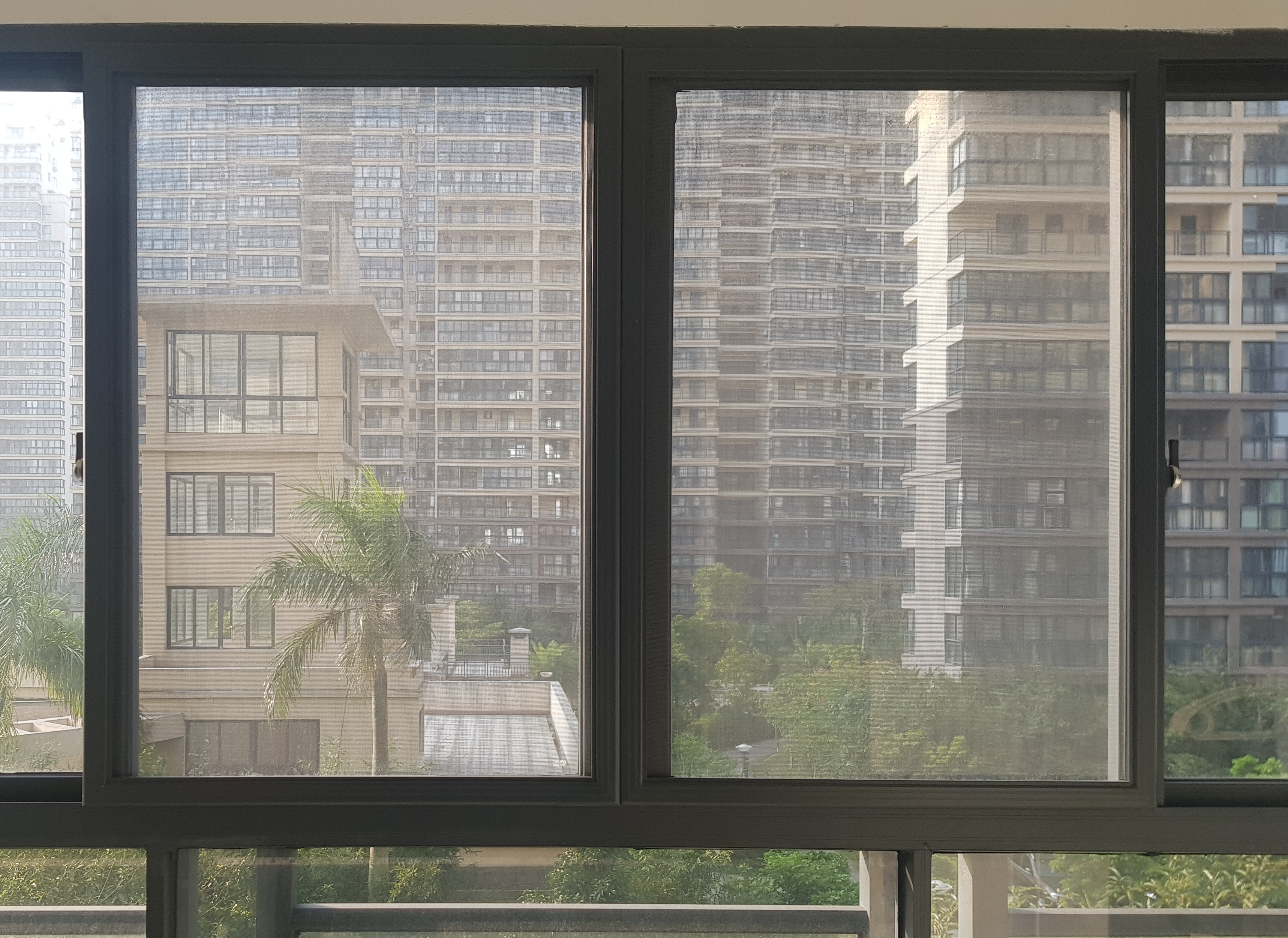

To be fair, there are more reasons why my in-laws preferred this apartment, other than the view (importantly the balcony was a bit bigger). But they also explicitly pointed out the good view, saying that it wasn’t only that the countryside view looked so impoverished, but also that the large apartment buildings conveniently blocked the sunlight from falling into the apartment. After all, if the sun was shining directly into the apartment, it would heat up quite a lot. There is undeniably some truth to this, but I’m not sure if this would have been a reason for me to prefer the high-rise view.
A little bit of relaxing noise
Now, years later, I was recently walking along the beach promenade of one of my favourite places in the world, in Las Palmas de Gran Canaria. It’s got a 3 kilometre long beach stretching from north to south and lots of apartment buildings (of just a few floors, though) with nice little cafés and restaurants on the ground floor overlooking the beach. I sometimes dream of owning one of the apartments there, but when walking along the promenade my in-laws voice sounds in my head: “These waves are so noisy, you won’t be able to sleep!”.

In fact, I did find some truth to this, but only some. The beach changes from south to north. In the south, the beach is narrow, with black sand and rocks and pebbles. The waves are high and the place is popular for surfing. The further you get up north, the wider the beach gets, the sand becomes white, the waves become shallow and gentle, and families with small children love to build their sand castles there. I did notice that the narrow rocky end does get quite noisy, an I’m certain that the people in the apartments there wouldn’t be able to have a video call on their balconies (not that that’s what they are there for). The northern end, however, being sandier and shallower, does have a much more gentle sound of waves, more like a comforting background noise. The restaurants and cafés will, however, most likely be noisier than the waves, so in fact, if I ever were to buy an apartment here, I would, like my parents-in-law, buy one in the second row.
The fact that apartments in the second row cost half as much as first row, certainly helps, but also shows that people here, as opposed to China, are willing to pay a lot of money the view… and the sound.
 Grammar and Tones
Leave a comment